TradingKey - Anthropic CEO Dario Amodei called for slowing the pace of AI capability development, dragging down AI-related stocks across the board. Meanwhile, surging U.S. Treasury yields and crude oil prices also weighed on the stock market. U.S. stocks fell modestly, with memory chip and optical communication stocks leading the losses, while software and cybersecurity stocks bucked the trend to gain.
At the close, the Dow Jones Industrial Average fell 0.29% to 52,421.20; the Nasdaq Composite Index slipped 0.56% to 26,186.41; and the S&P 500 Index lost 0.48% to 7,619.98.
Tech Stock Performance
Google (GOOGL) bucked the trend to gain 3.22%, closing at $349.39.
Alphabet's Waymo announced the launch of its paid Robotaxi service in Las Vegas, making it the 15th U.S. city where it offers ride-hailing services. The company stated that the service will begin on Monday and be rolled out in phases, starting with dozens of vehicles initially and planning to expand to hundreds in the future. Waymo noted that the Las Vegas Robotaxis will not have highway access initially, with airport pickups and highway services to be added in later phases.
Among mega-cap tech stocks, Google (GOOGL) rose 3.22%, Meta Platforms (META) gained 2.71%, Microsoft (MSFT) advanced 1.97%, and Apple (AAPL) climbed 0.24%. On the downside, Broadcom (AVGO) fell 4.77%, TSMC (TSM) dropped 3.38%, Nvidia (NVDA) declined 3.36%, SpaceX (SPCX) slid 2.02%, Tesla (TSLA) lost 1.77%, and Amazon (AMZN) slipped 1.26%.
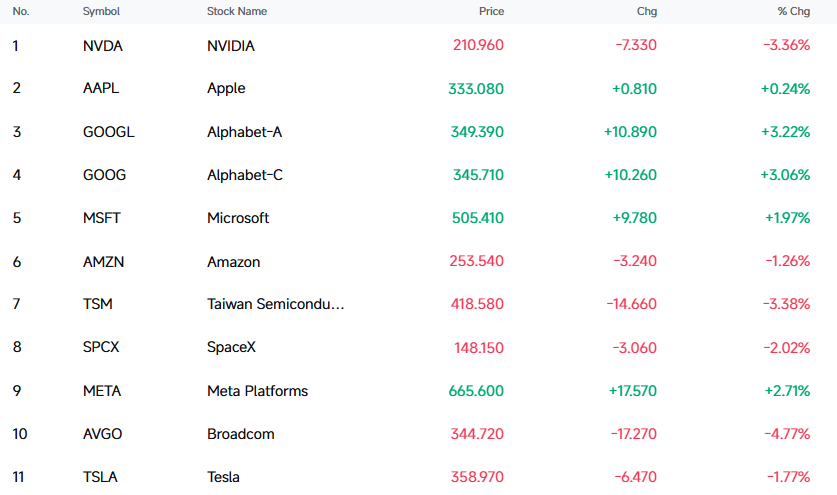
[Source: FutuBull]
The Philadelphia Semiconductor Index fell 5.86% to 11,131.28 points, with all 30 constituents posting losses.
Among memory stocks, SK Hynix (SKHY) fell 7.60%, Micron Technology (MU) dropped 5.25%, SanDisk (SNDK) declined 4.98%, Western Digital (WDC) slid 4.53%, and Seagate Technology (STX) lost 2.97%.
Among chip stocks, Arm Holdings (ARM) plunged 9.74%, Intel (INTC) fell 5.59%, AMD (AMD) dropped 4.40%, and Qualcomm (QCOM) slipped 1.00%.
Among optical communications stocks, Corning (GLW) plummeted 13.74%, Nokia (NOK) plunged 13.25%, Lumentum (LITE) dropped 9.92%, Marvell Technology (MRVL) fell 7.32%, Amphenol (APH) declined 6.36%, and Broadcom (AVGO) lost 4.77%.
Company News
Nvidia Expands CUDA-Q Platform, Launches Fault-Tolerant Quantum Computing Orchestration Layer
Nvidia announced the expansion of its open-source CUDA-Q platform, introducing the CUDA-Q Logical orchestration layer to provide programmable and verifiable tools for fault-tolerant quantum computing application development, supporting application scenarios such as drug discovery, financial modeling, and materials development. Nvidia stated that Fermi National Accelerator Laboratory used CUDA-Q Logical to shorten fault-tolerant algorithm development time from the usual approximately 5 months to 3 weeks, boosting efficiency by about 7-fold. In addition, QUOPS, a quantum computing benchmark developed by Sandia National Laboratories, has joined CUDA-Q to evaluate cross-platform progress in quantum computing hardware toward practical fault-tolerant quantum computing.
Anthropic Launches Claude Product for Financial Advisors
Anthropic has launched a Claude product tailored for financial advisors, having completed integration with financial analysis and risk management technologies operated by institutions including BlackRock and Vanguard. According to senior executives from Anthropic and BlackRock, the system, named "Claude for Financial Advisors," aims to accelerate tasks including research, administration, and portfolio oversight. This marks one of the AI company's most significant moves into the financial sector to date. The feature also connects to tools from firms such as Charles Schwab and iCapital, building on financial services AI agents previously introduced by Anthropic that can handle tasks such as writing pitch materials and reviewing financial statements.
Microsoft Issues Interim Code of Conduct to Limit AI Model Usage
Days after the leaders of Anthropic and OpenAI agreed to slow development pace, Microsoft released an interim code of conduct placing restrictions on artificial intelligence models. The company, one of the leading cloud service providers, aims to be seen as a responsible AI actor. "We received feedback that people want to see a clearer commitment: AI always serves humans, rather than attempting to replace humans," Mustafa Suleyman, who leads the company's model development, said in an interview with CNBC. "We received a lot of feedback emphasizing that AI should not create dependency, nor should it be sycophantic, but should always promote human judgment, autonomy, and agency." Suleyman stated that while these guidelines had been in the works for about five months, Microsoft chose to publish them now in light of recent discussions.
Industry & Macro News
Saudi Arabia Reportedly Increases Hormuz Crude Exports This Month, Plans to Further Boost Supply
Saudi Arabia is seeking to further increase oil exports through the Strait of Hormuz, according to people familiar with the matter. The volume of crude transported by Saudi Arabia through the Strait of Hormuz in the first 10 days of this month has already increased from August, and the kingdom is currently looking to expand supply further. Sources revealed that in early September, Saudi Arabia had raised its overall export volume to nearly 4 million barrels per day, with about 1 million barrels per day exported via the Strait of Hormuz and the remainder shipped through the Red Sea port of Yanbu.
BofA Says Stock Market Entering Period of Seasonal Weakness, Market Correction Long Overdue
Savita Subramanian, head of US equity and quantitative strategy at Bank of America, raised her S&P 500 index target while warning that US stocks still face interest rate risks and pullback pressures are building up. Subramanian raised her year-end 2026 target for the S&P 500 to 7,400 from 7,100 points. "We are entering a period of seasonal weakness, and in our view, a market correction is long overdue," Subramanian wrote in a note to clients on Monday. She pointed out that since 2026, the S&P 500 has experienced only one 5% pullback, which occurred in March, compared with a historical average of about three times a year; corrections of 10% or more typically happen once a year, with the last one dating back to the spring of 2025. In addition, about half of the bear market warning indicators tracked by BofA have been triggered.
Find out more